Silk Road Journey
Asia · Turkey · Iran · Uzbekistan · China
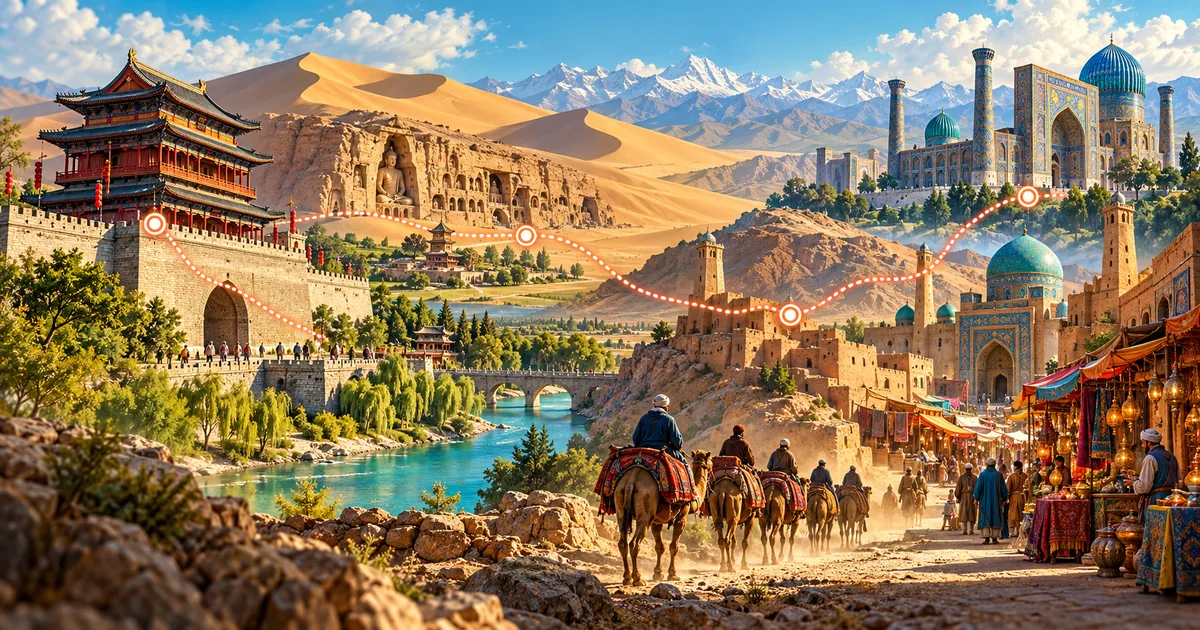
Join a virtual caravan across great Silk Road cities. Trading cities, blue domes, and desert crossings. This is the exact 5,200 km itinerary currently available in the WalkQuest app, with 14 milestones in this order: Istanbul → Ankara → Goreme → Tabriz → Tehran → Mashhad → Bukhara → Samarkand → Tashkent → Osh → Kashgar → Turpan → Dunhuang → Xian. Istanbul: A bridge between continents and cultures. Istanbul has been capital of three major empires. Ankara: An Anatolian capital layered with a Roman temple, a hilltop citadel, and modern museums. Ankara became the capital of the Republic of Turkey in 1923. Goreme: A Cappadocian settlement surrounded by volcanic valleys, cave churches, and rock-cut homes. The Goreme Open-Air Museum preserves a major complex of medieval rock-cut churches.
Tabriz: A historic Iranian trading city centered on one of the Silk Road's great covered bazaars. The Tabriz Historic Bazaar Complex is a UNESCO World Heritage Site. Tehran: A mountain-framed capital with deep history. Tehran sits near the Alborz Mountains. Mashhad: A major Khorasan city shaped by pilgrimage, poetry, bazaars, and routes toward Central Asia. Mashhad grew around the shrine of Imam Reza, one of the world's largest mosque complexes. Bukhara: An oasis city of blue domes, brick minarets, trading halls, and preserved caravan history. Bukhara served for centuries as a major center of trade and Islamic learning. The journey finishes at Xian after 5,200 km.
Distances and milestone counts on this page are generated from the same route catalog used by the app, so the guide matches the experience users unlock. Silk Road Journey is a 5,200 km virtual walking journey across Turkey, Iran, Uzbekistan, China. The itinerary connects Istanbul, Ankara, Goreme, Tabriz, using real geography and documented heritage to turn daily movement into a clear long-term adventure. Istanbul, Ankara, Goreme are among the route's defining chapters. At 10,000 steps per day, the full distance is designed to take about 40 weeks, so progress grows through steady routines rather than one intense effort. Each milestone unlocks concise historical, cultural and landscape context, while digital stamps make the scale visible. Walk anywhere that is safe and convenient: Health Connect steps advance the virtual map even when the real-world route includes sea crossings, high mountains or long transfers.
Highlights
- ✓Explore Istanbul, Ankara through Xian
- ✓5,200 km · 40 weeks at 10,000 steps/day
- ✓Route: Turkey, Iran, Uzbekistan, China
- ✓Landmarks: Istanbul, Ankara, Goreme
- ✓Cities and milestones: Goreme, Tabriz, Tehran, Mashhad
- ✓Collectible stamps: 14
Cities and milestones
Istanbul
Turkey
A bridge between continents and cultures. Istanbul has been capital of three major empires.
Ankara
Turkey
An Anatolian capital layered with a Roman temple, a hilltop citadel, and modern museums. Ankara became the capital of the Republic of Turkey in 1923.
Goreme
Turkey
A Cappadocian settlement surrounded by volcanic valleys, cave churches, and rock-cut homes. The Goreme Open-Air Museum preserves a major complex of medieval rock-cut churches.
Tabriz
Iran
A historic Iranian trading city centered on one of the Silk Road's great covered bazaars. The Tabriz Historic Bazaar Complex is a UNESCO World Heritage Site.
Tehran
Iran
A mountain-framed capital with deep history. Tehran sits near the Alborz Mountains.
Mashhad
Iran
A major Khorasan city shaped by pilgrimage, poetry, bazaars, and routes toward Central Asia. Mashhad grew around the shrine of Imam Reza, one of the world's largest mosque complexes.
Bukhara
Uzbekistan
An oasis city of blue domes, brick minarets, trading halls, and preserved caravan history. Bukhara served for centuries as a major center of trade and Islamic learning.
Samarkand
Uzbekistan
Blue domes and caravanserai memories. Samarkand was a key Silk Road crossroads.
Tashkent
Uzbekistan
A leafy Central Asian capital where old mahallas and markets meet monumental modern avenues. Tashkent has long connected the settled oases of Transoxiana with routes toward the Tian Shan.
Osh
Kyrgyzstan
A Fergana Valley market city beneath sacred Sulayman Mountain. Osh has served travelers and traders on Central Asian routes for more than two millennia.
Kashgar
China
Markets, desert routes, and old trading paths. Kashgar has been a trading hub for over two millennia.
Turpan
China
A desert oasis of vineyards, ancient ruins, and underground irrigation north of the Taklamakan. Turpan's karez channels carry mountain water underground to fields in the arid basin.
Dunhuang
China
A Gansu Corridor oasis known for painted caves, dunes, and caravan-route archaeology. The Mogao Caves preserve nearly a thousand years of Buddhist art beside the Silk Roads.
Xian
China
End near ancient walls and terracotta warriors. Xian was the eastern starting point of the Silk Road.
Landmarks
Istanbul
A bridge between continents and cultures. Istanbul has been capital of three major empires.
Ankara
An Anatolian capital layered with a Roman temple, a hilltop citadel, and modern museums. Ankara became the capital of the Republic of Turkey in 1923.
Goreme
A Cappadocian settlement surrounded by volcanic valleys, cave churches, and rock-cut homes. The Goreme Open-Air Museum preserves a major complex of medieval rock-cut churches.
Tabriz
A historic Iranian trading city centered on one of the Silk Road's great covered bazaars. The Tabriz Historic Bazaar Complex is a UNESCO World Heritage Site.
Tehran
A mountain-framed capital with deep history. Tehran sits near the Alborz Mountains.
Mashhad
A major Khorasan city shaped by pilgrimage, poetry, bazaars, and routes toward Central Asia. Mashhad grew around the shrine of Imam Reza, one of the world's largest mosque complexes.
Fact sources
Hero image: AI-generated original artwork by OpenAI for WalkQuest.
Related routes



Open in WalkQuest
Explore Silk Road Journey, a 5,200 km virtual walking route with real cities, landmarks and collectible stamps. Start your WalkQuest journey today.